15K Steps, One PS5 & the Two Weeks That Changed How We Move
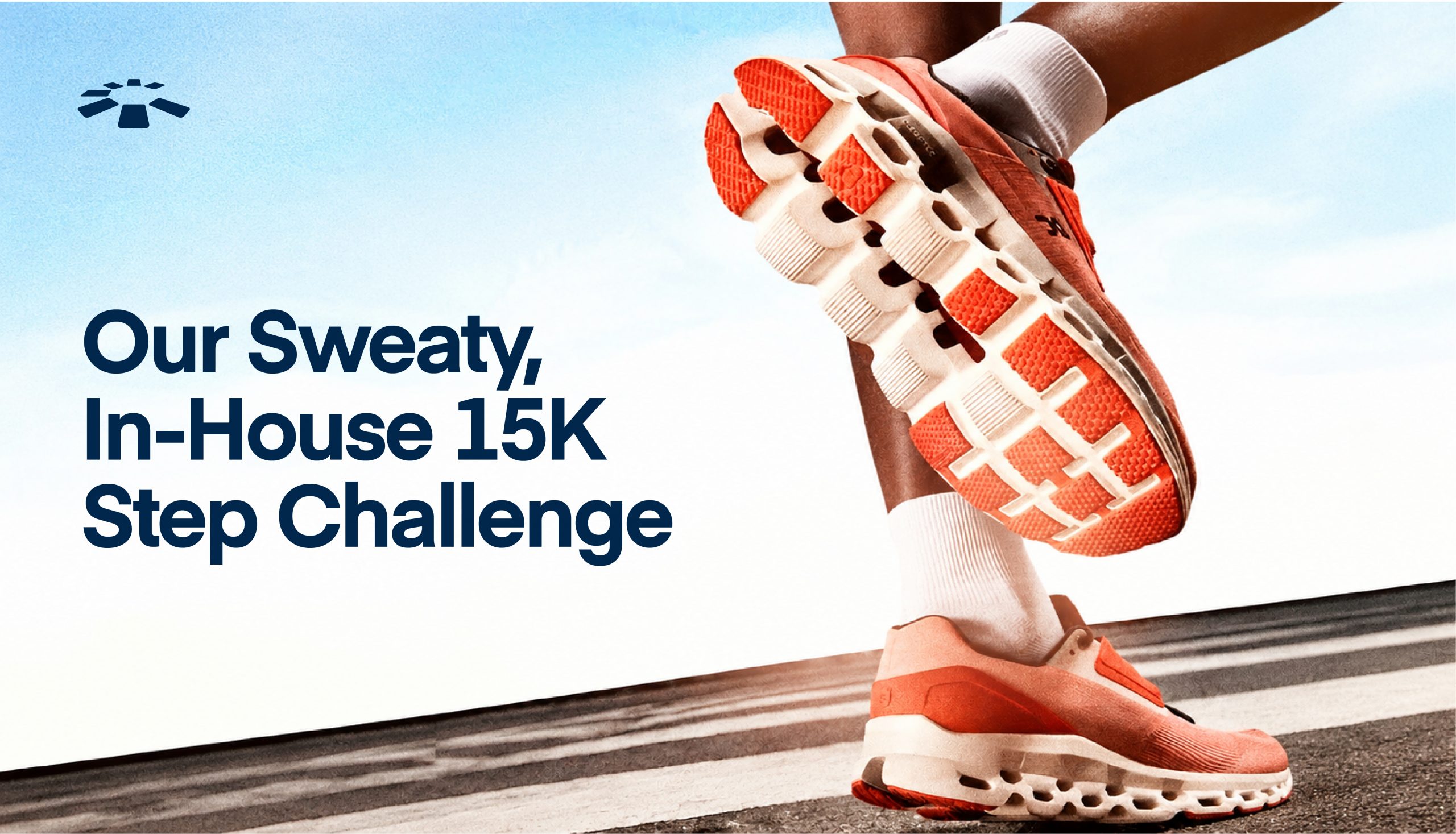
What would you do for a PS5?
Over here, some of us were ready to walk nearly the distance from Lagos to Cotonou (roughly 100,000 steps) for the chance to take one home.
Not me and a couple of other people, though. We just wanted the new Apple Watch that came as the second-place prize. We’d have sold the PS5 to add to December Balling money anyway, so the Watch should have been just fine.
But let us not get ahead of ourselves.
On the random, semi-quiet Friday morning of July 24th, the good people of our HR department dropped some interesting news on Slack.
Over 100 of us soon saw what was cooking: in an attempt to do our health (and lower-body muscles in particular) some good, a step challenge was starting within the company, and everyone was encouraged to put their best foot forward, and then the next foot forward.
(Pun above intended.)
But what was at stake, aside from egos and muscle strains?
Some of the most exciting rewards yet.
The Big Announcement
That morning, Team HR told us what to expect with this 15K steps-a-day challenge.
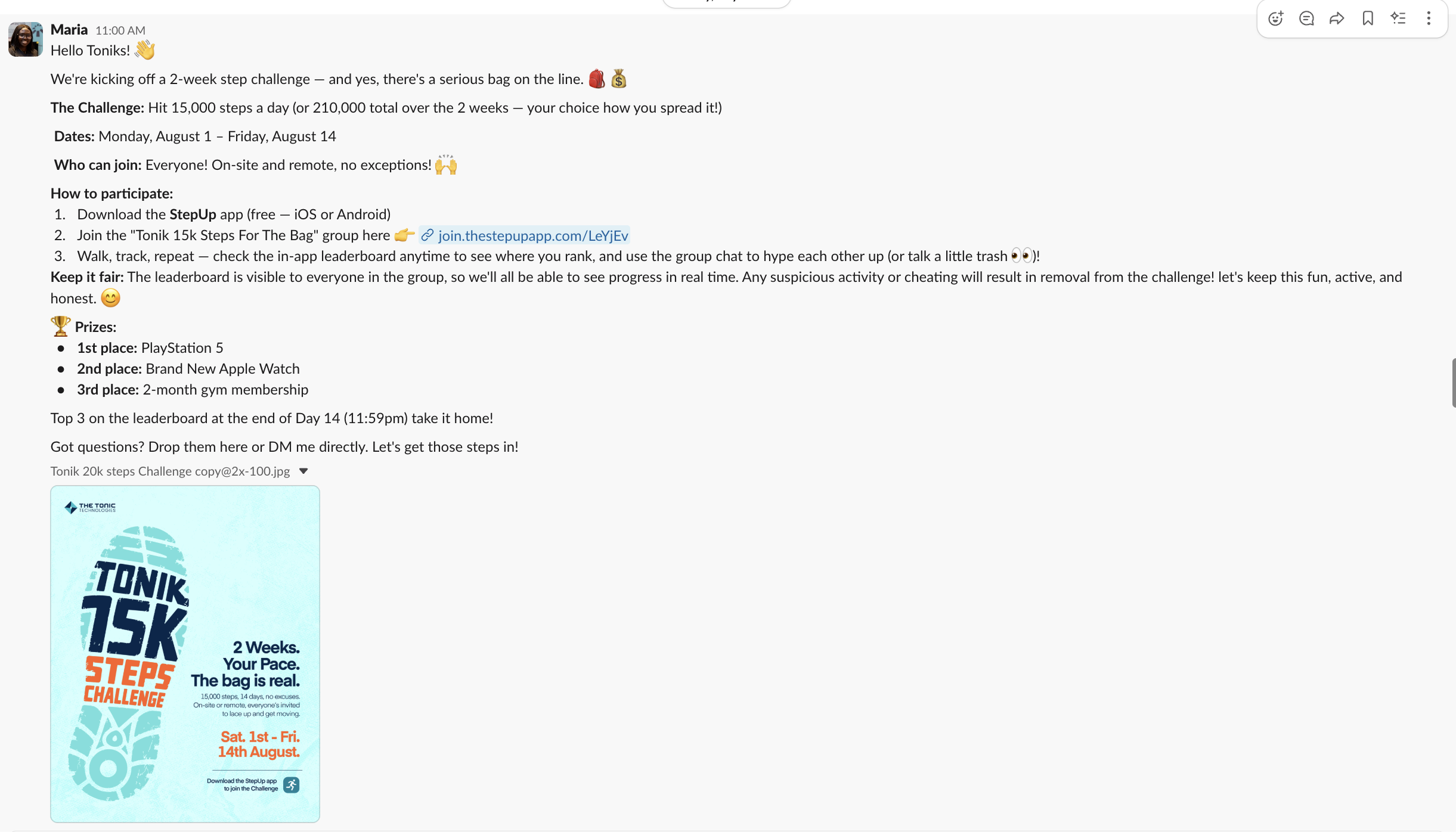
Starting August 1st and running until August 14th, every participating team member (on-site and remote) had one goal: hit 15,000 steps a day, or spread your 210,000 total steps across the two weeks however you liked.
First, we had to download the Step Up app, which was used for this challenge, join the ‘Tonic 15K Steps for the Bag’ group, walk, track, and repeat. For transparency, the app had a live leaderboard so anyone could check the rankings in real time.
There was also a group chat for general motivation, updates, and — as was encouraged, so hold HR responsible for this one — a surprisingly healthy amount of trash talk.
Now, the prizes. First place was a tear-rubber PlayStation 5. Second place was also pretty neat: an Apple Watch. And third place? A two-month gym membership.
As you can already guess, the reaction was immediate. In the most polite possible terms: people lost their minds.
Every group chat was buzzing with life all weekend after that announcement.
The competitive instincts that usually stay confined to quarterly targets came out swinging. People who had never cared about their step count were suddenly checking their phones every twenty minutes, doing mental math at their desks, and finding increasingly creative ways to move their bodies without technically stopping work.
First Reactions: “Wait, How Many Steps?”
We can all admit it: time flies when you work remotely, because you can sit in one spot and only realise 5 hours have slipped by like it’s nothing when you stand up to grab some water, and your joints feel stiffer than a poorly oiled machine.
Yet, most remote workers have quietly made peace with this.
When your commute is the distance between your bed and your desk, or in some cases, your bed and your couch, and then your couch and your desk, with a brief detour through the kitchen, you are not moving very much.
You know it, your body knows it, and your smartwatch (if you have one) definitely knows it, because it keeps sending you those passive-aggressive notifications asking if you’ve stood up yet.
So when HR announced 15,000 steps a day, the first wave of responses was something like, “I’m sorry, fifteen thousand?” Because for a lot of us, especially the remote team, our previous daily average was somewhere between 120 (unbelievable, I know) and 4,999 steps, max.
The on-site crew had a slight natural advantage: commuting to and from the office every few days, moving between meetings, and the general activity of being in a physical space with other humans. But 15,000 steps is 15,000 steps, and even they had to adjust.
Still, nearly everyone signed up.
The Early Starters and the Do-Too-Muchs
Here’s the thing about announcing a challenge a week before it officially starts: some people will use that week to give their muscles a head start, even if, technically, their steps didn’t start counting (officially) until the new month.
But those people didn’t mind.
Before August 1st, a handful of team members were already logging serious numbers, warming up their legs and their strategies before the gun went off. The rest of us watched this with a mixture of admiration and mild suspicion, as typical Nigerians. Were early steps going to count? Were they just practising? Were they trying to psyche the rest of us out?
(The answer, for the record: they were absolutely trying to psyche the rest of us out. And it worked, a little.)
By the time August 1st officially kicked off, the leaderboard started filling up fast. And that’s when we really started to see who among us had the gift of trekking.
A certain group of boys and girls showed up with step counts that made the rest of us do a double-take. Did they discover a hack the rest of us didn’t know? Had they hired a dedicated assistant to wear their watches and walk in circles? Did they decide that sleeping was optional for those two weeks?
We will never know. Walk-aholics, all of them.
The Group Chat During These Two Weeks: A Documentary
If you want to understand what our 15K Step Challenge really felt like from the inside, the group chat is your main source.
What started as a place to share encouragement quickly evolved into something much more entertaining.
Like in every other social setting, there were the motivators: the ones posting morning check-ins at 6 am like “Day 4, let’s go, let’s go!”
There were the strategists, dropping tips on how to squeeze more steps out of your day: “Walk while you’re on calls.” “If you’re watching TV, just pace.”
And then there were the comedians.
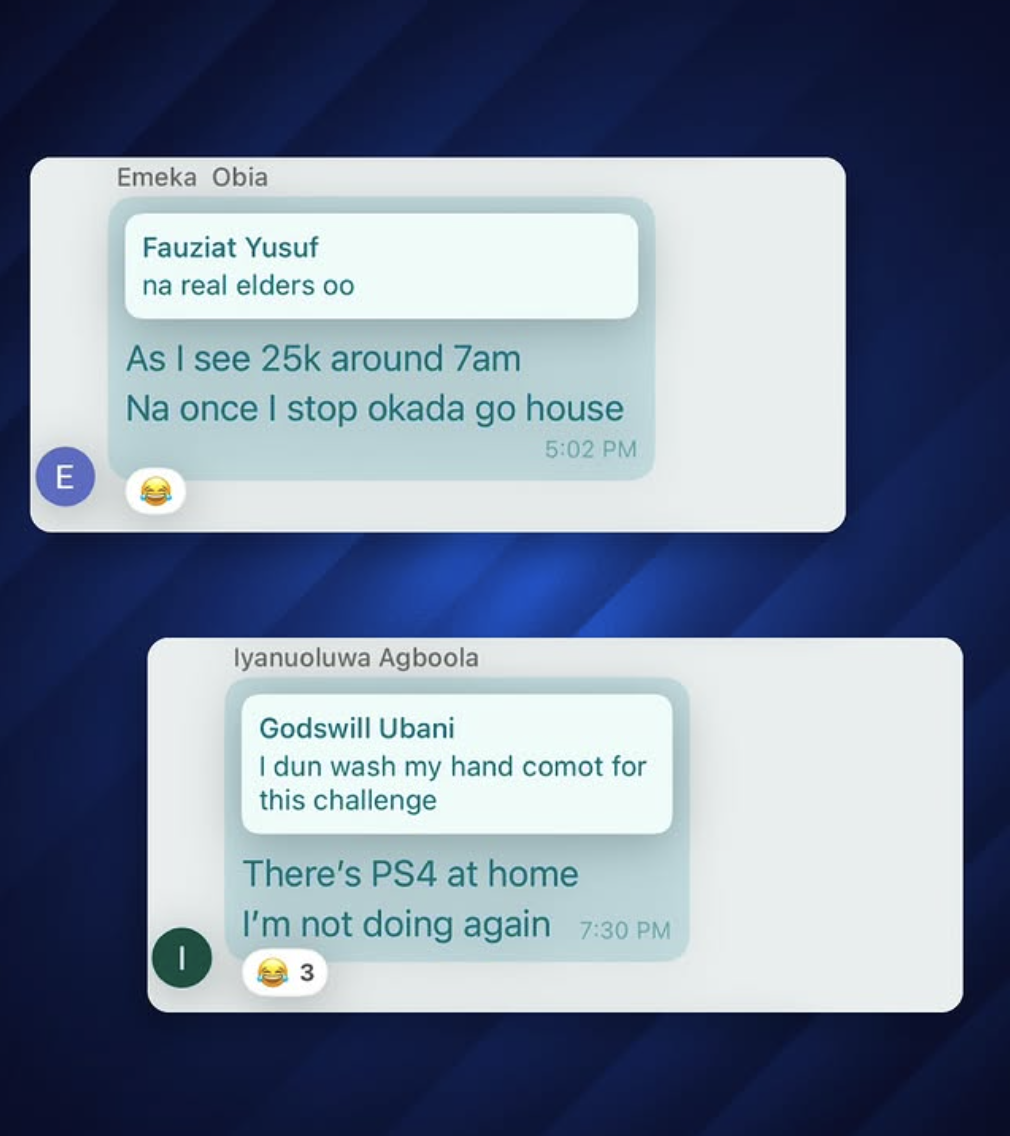
“At this rate, someone is going to trek to Cotonou and back.”
“HR had better deny any sick leave for arthritis sha. That’s all I know.”
People started doing the math on how many hours of walking it would take for one person to do 90k+ steps. Even our CEO had something to say, wondering if any actual work was happening if some people had this much time on their hands for walks.
(And fair question too.)
Meanwhile, HR did NOT expect dozens of people to hit and cross 15k every single day for two weeks; they started joking about raising the target to one million steps, just to see what would happen.
(But since this isn’t a fitness community and our millions of users are the reason we can afford such pricey rewards, we decided to behave ourselves.)
How People Actually Hit 15K: The Creative and the Slightly Unhinged
One of the most interesting things about watching your colleagues do something hard in real time is learning what they’re actually made of. And the Step Challenge revealed some genuinely creative (and slightly unhinged) problem-solving.
We asked around. Here’s what people figured out.
Some of us who work remotely remembered that treadmills were a brilliant idea. Some others discovered that pacing inside the house is a completely viable strategy when you have nowhere particular to be. Their living room became a track, and they got in a surprising number of steps done without ever opening their front door.
Then there were the early risers: a contingent of challengers decided the best time to bank steps was before the workday started.
That’s how 5:30AM walks became a thing. One person reportedly set an alarm for 4AM every day of the challenge, and we chose not to ask follow-up questions because some things are between a person and their PS5.
And then there were the ones who left everything for evenings. All day at their desks, and then, from maybe 7PM onwards, they would go absolutely feral with the step count.
One person confessed: “I don’t think I’ve ever seen my street this many times in my life. I know every pothole now, and a lot more of my neighbours.”
Talk about wiping two birds with one stone.
The Ones Who Surprised Themselves
Beyond the competition, the trash talk and the leaderboard obsession, something else happened.
This 15K Step Challenge was the reason a lot of us discovered we were more capable of stretching ourselves than we’d thought.
One team member from Marketing told us she had never hit 15,000 steps in a single day before this challenge. Not once. Her previous personal best was somewhere around 7,000, on a particularly active day. The challenge didn’t just push her to 15K, it pushed her past that number consistently for fourteen days straight.
Another team member said: “I kept checking the leaderboard every day, thinking I was competing against everyone else. But somewhere in Week 2, I realised I was actually competing against my Day 1 self. And that version of me felt very far away.”
The Results & The Part After It Ended
When August 14th arrived, and the challenge closed, the final leaderboard told the full story of two weeks of competitive walking, creative problem-solving, and a level of physical effort that was commendable, to put it mildly.
But there’s something wonderful about challenges like this: they never just wrap up.
We’re in September now, and that leaderboard is still being checked till today. People are still logging in, still looking at the numbers (according to the live data), and still taking their daily steps seriously.
There’s no prize anymore, but a new habit has been formed, and it’s not one that a lot of us will unlearn.
If that’s not the biggest win, we don’t know what is.
The Reason This Challenge Worked So Well
We’ve done a lot at Cardtonic to build culture: team getaways, daily lunches, milestone celebrations, quarterly bonuses for morale. And those things work, in their own ways.
But the Step Challenge worked differently, and we’ve been thinking about why.
Part of it was the prize: a PS5 is something that most people actually want, and it made the competition feel worthwhile, but plenty of challenges have good prizes.
We think what made the difference was that the challenge met people where they already were. It didn’t require a specific skill; it didn’t need special equipment or prior experience. It required your body and the willingness to care about your wellness enough to move a bit more today than you did the day before.
Remote staff could do it from their living rooms, on-site staff could do it on their way to work, and double down on their off days. Everyone had an equal shot.
It also gave people something to talk about that wasn’t work. And in a largely remote company, where most of our daily interactions are task-related or project-related, having a shared non-work obsession for two weeks does something to the culture that’s hard to manufacture any other way.
“Remember the step challenge?” will be a sentence said here for a long time. We’d bet on it.
One Last Thing (a.k.a. Our Disclaimer)
If you’re reading this and you’re on the Cardtonic team: HR is not responsible for any arthritis, knee complaints, or back pain that occurred between August 1st and August 14th. (They asked us to say that.) (We’re mostly joking. Mostly.)
And if you’re reading this and you’re not on the team: we hire. Just saying. The benefits include the usual things — good work, great people, competitive pay — and occasionally a company-wide initiative that will make you walk more steps in two weeks than you have in the past six months, for the chance to win a PS5, an Apple Watch, and a two-month gym membership fully covered (even if you’re a Nepo baby that uses iFitness).
Now, if you’ll excuse some of us, we have a leaderboard to check for the third time today.

 Get on iPhone
 Get on Android